Automated Inspection Cell for Dental Implant Components
This solution brings accuracy, repeatability, and full automation to the quality control process of dental implant components. Designed for manufacturers, it combines advanced sensors with integrated software to enable 100% in‑line inspection of all external and internal features, ensuring complete traceability for every part. The result is reduced scrap, higher reliability, and a more efficient and controlled quality process.
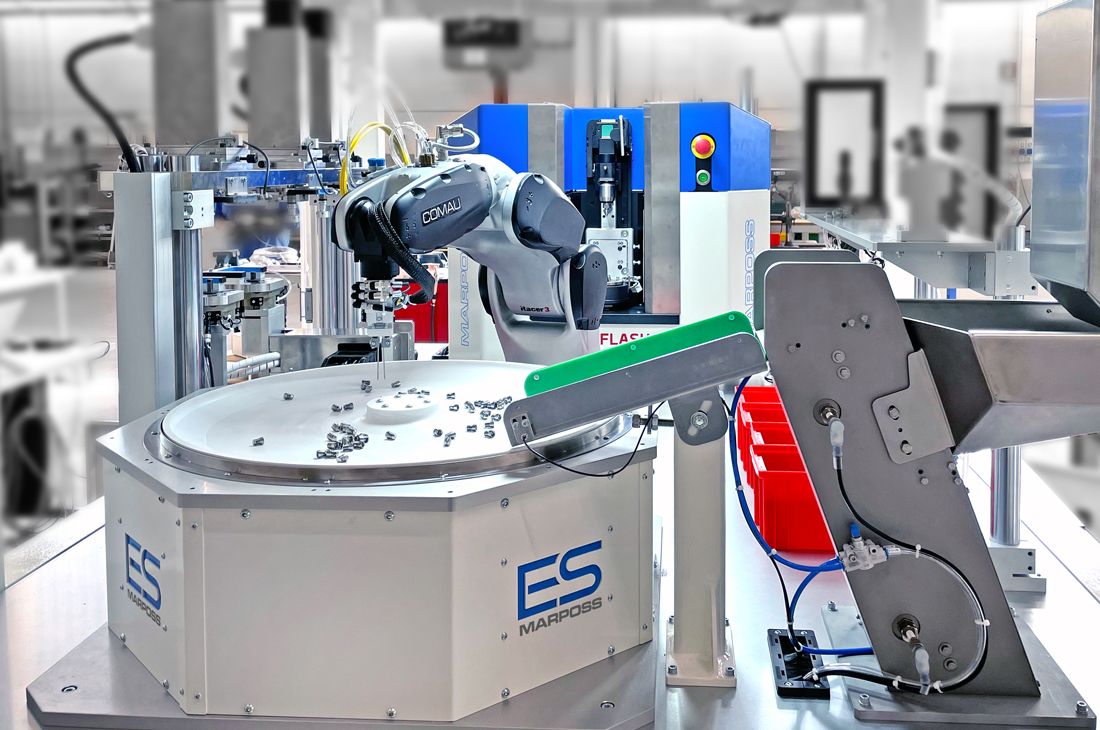
The Inspection Cell is a flexible and modular solution designed to handle a wide variety of dental implant components. A single integrated software platform manages the entire cell and allows operators to easily add new part types, ensuring fast adaptation to evolving production needs.
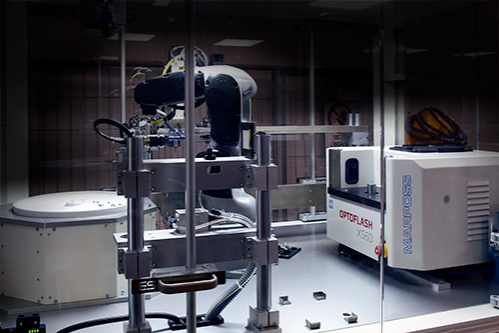
The cell is composed of modular stations,each of which can be activated or deactivated via the interface, and interconnected through a robotic handling system that guarantees stable, repeatable, and fully automated workflows.
Station 1 — Feeding & Identification
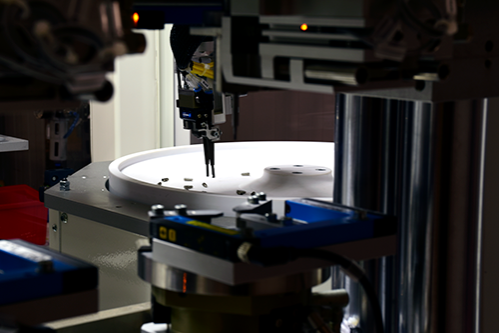
The operator loads the entire production batch into a hopper that feeds a rotating plate. Components are spread across the surface and identified by an overhead camera, enabling precise robotic picking.
Station 2 — Cleaning & Reclamping
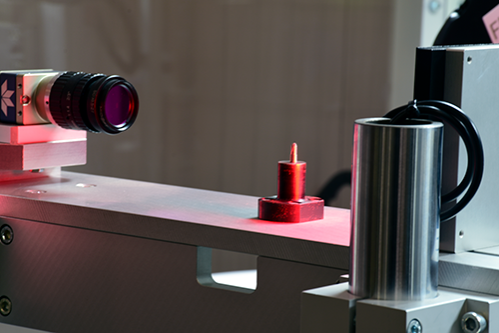
Picked components are transferred to a cleaning station where blowing and suction remove machining residues. A second camera then refines the part orientation, ensuring optimal reclamping in the robot grippers for the subsequent inspection steps.
Station 3 — External Feature Measurement (OF XS)
The internally designed and manufactured OF XS uses high‑resolution cameras to perform micron‑accurate measurement of all external features. Thanks to its unique 2D sensor architecture, it delivers extremely short cycle times while ensuring complete inspection of threads, diameters, lengths, and tapers.
Station 4 — Internal Feature Measurement
This station enables micron‑level inspection of internal geometries that would otherwise be impossible to measure with traditional methods. It captures hex geometry, hex depth, entry diameter, taper, and total depth with high repeatability.
Station 5 — Functional Thread Inspection
A calibrated gauge mounted on a rotary‑linear electric axis performs a fully automated functional inspection of the internal thread, verifying its conformity under controlled conditions.
Station 6 — Output
Processed components are automatically deposited into dedicated boxes for good parts and categorized rejects, ensuring a clean and traceable end‑of‑line workflow.
100% Inspection of Every Component
Complete control of all external and internal features ensures full compliance and eliminates the risk of undetected defects.
Significant Reduction in Labor and Operating Costs
The extremely short cycle time replaces the work of up to eight operators, drastically reducing labor costs. Combined with the system’s minimal maintenance requirements, overall operating expenses are substantially lowered.
Full Traceability Across the Entire Process
Each batch is tracked through every station, generating a complete digital record that supports audits and regulated manufacturing environments.
Flexible Configuration Through New Part Programs
A single software platform allows operators to easily create and add new part programs, enabling the inspection of additional component types as production evolves.
High Repeatability and Operator‑Independent Results
Robotic handling and automated measurement eliminate variability, ensuring stable and consistent inspection performance.
Fast Cycle Times with Complete Measurement Coverage
Advanced optical and non‑contact technologies deliver micron‑accurate inspection without compromising throughput, making the process faster, leaner, and more efficient.
Seamless Integration into Existing Production Lines
The cell communicates with factory systems and supports modern manufacturing environments, from small batches to high‑volume production.
Standard machine technical specifications:
-
15‑second cycle time
-
Up to 1,000 different components
-
Up to 800 components per batch
-
Maximum measurable external diameter: 20 mm
-
Maximum measurable external length: 60 mm
-
Maximum measurable internal diameter: 3.5 mm
-
Measurement uncertainty up to 1 micron
-
3D reconstruction of implant geometry for advanced dimensional analysis
-
Real‑time SPC (Statistical Process Control) data output
-
Minimal retooling required
BROCHURES AND MANUALS
| Brochure | |
|---|---|
| English |
AUTOMATIC CELL FOR DENTAL IMPLANTS: (846.07kB)
|
| Italian |
AUTOMATIC CELL FOR DENTAL IMPLANTS: (844.50kB)
|